
AI in customer service is software that reads customer messages, works out what each person needs, and replies on its own, day or night. It handles repeat questions about order status, sizing, and shipping. Anything complex goes to a human, with the full chat history attached.
Slow replies cost online stores sales. Baymard Institute's research shows the average cart abandonment rate has hovered around 70% for over a decade. Some shoppers leave because a question about fit or delivery went unanswered.
Below: how it works, where it helps, where it fails, and how to set it up. For the wider picture, see our guide to automating customer messages for an online store.
How Does AI Customer Service Work?
AI customer service works in four steps. It reads the message, identifies the intent, finds the answer in your business information, and then replies or hands the chat to a person. Intent means the goal behind the words. "Where's my parcel?" and "order not here yet" share one intent: order status.
Most tools use natural language processing (NLP), the branch of AI that understands everyday language. Newer tools add large language models (LLMs), the technology behind ChatGPT, so replies sound natural rather than scripted.
| Step | What happens | Example |
|---|---|---|
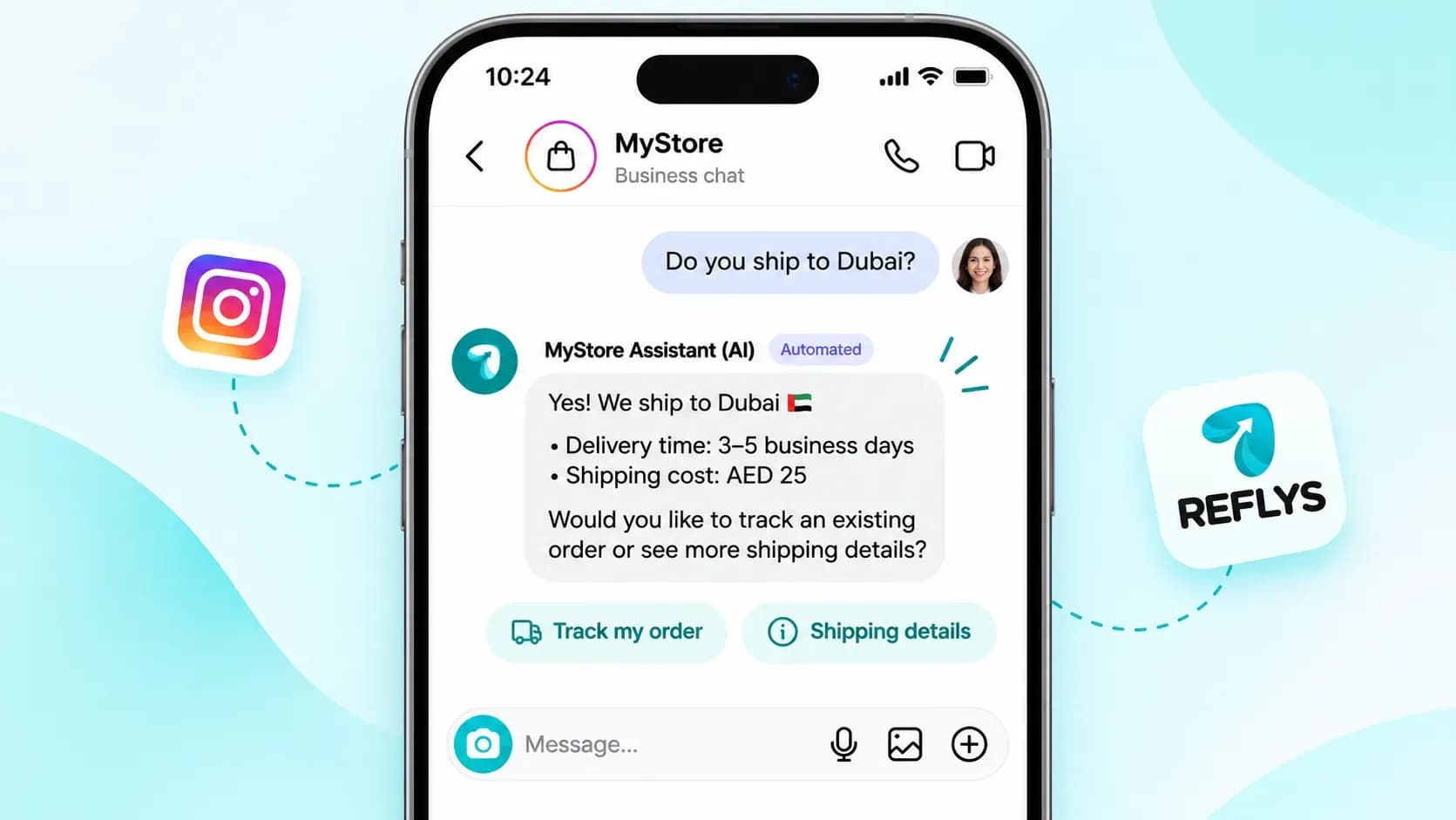
| 1. Read | A message arrives in a DM, comment, or chat | "Do you ship to Dubai?" |
| 2. Understand | AI matches the intent, even with typos or slang | Intent: shipping question |
| 3. Answer | AI pulls the reply from your policies or store data | Shipping time and cost |
| 4. Hand off | Anything unclear goes to a human with context | A damaged-item complaint |
AI is only as accurate as the policies and product details you give it.
Benefits of AI in Customer Service
The main benefits of AI in customer service are 24/7 replies, more productive agents, lower support costs, and consistent answers. Customers now expect round-the-clock help. Zendesk's CX Trends 2026 report found that 74% of consumers expect 24/7 service because of AI.
More productive human agents. A study of 5,179 support agents, published by the National Bureau of Economic Research, found that an AI assistant raised issues resolved per hour by 14% on average. Newer and less-skilled agents improved by 34%.
Lower costs over time. Gartner predicts that by 2029, agentic AI will resolve 80% of common customer service issues without human help. Agentic AI is AI that can take actions, such as processing a return, not just answer questions. Gartner expects a 30% cut in operating costs. Treat that as a forecast, not a promise.
Consistent answers. AI gives the same return-policy answer at 9 a.m. and 3 a.m.
Try it on your own DMs: Reflys' AI Flow Builder turns a plain-language goal into a working automation. Start your 7-day free trial.
AI Customer Service Examples for Online Stores
The most useful AI customer service examples handle high-volume, low-risk questions: order tracking, product details, abandoned carts, and lead capture. Start with the question your team answers most often.
| Use case | What the AI does | Common channels |
|---|---|---|
| Order status | Shares order and shipping updates | WhatsApp, Messenger |
| Product questions | Answers size, stock, and compatibility questions | Instagram DMs, TikTok |
| Cart recovery | Sends a reminder or discount code after a shopper leaves | |
| Comment-to-DM | Sends a product link when someone comments a keyword like SHOP | Instagram, TikTok |
| Bookings | Collects date, time, and contact details | WhatsApp, Messenger |
| Lead qualification | Asks about needs, then routes ready buyers to your team | All channels |
A Reflys restaurant client used automated WhatsApp follow-ups to grow monthly online orders by about 35%, from 1,200 to 1,620, with no ad spend. Its abandoned-cart recovery rate rose from 6% to 22% (read the case study).
Some of this needs no tool. Pin a comment telling followers which keyword to drop, and save your 10 most common answers as quick replies.
What Are the Risks of AI in Customer Service?
The biggest risks are customers who can't reach a person, wrong answers, and broken platform rules. A Gartner survey of 5,728 customers found that 64% would prefer companies didn't use AI for customer service. Their top worry was that AI would make it harder to reach a human.
Wrong answers are your responsibility. In Moffatt v. Air Canada (February 2024), a Canadian tribunal held the airline liable for incorrect fare information from its website chatbot. Base AI answers on your written policies, and review replies weekly.
Platform rules apply to bots. On Messenger and Instagram, businesses can reply within a 24-hour standard messaging window after most customer actions, under Meta's messaging policy. A human agent can reply for up to 7 days with the Human Agent tag, but only manually.
WhatsApp has its own rule. Since January 15, 2026, it bars general-purpose AI chatbots from its business platform, TechCrunch reported. Bots serving a business's own customers are still allowed.
Three habits keep AI safe:
- Offer a clear "talk to a person" option in every flow.
- Tell customers when they're chatting with AI.
- Avoid tools that scrape data or send unsolicited bulk DMs. They break platform terms.
How to Choose AI Customer Service Tools
Choose an AI customer service tool by checking five things: official platform APIs, channel coverage, store integration, human handoff, and clear pricing. An API (application programming interface) is the approved connection a platform like Meta provides.
| What to check | Why it matters | Question to ask |
|---|---|---|
| Official APIs | Unofficial tools risk account restrictions | Is it built on Meta's and WhatsApp's official APIs? |
| Channels | Customers message you in many places | Does it cover Instagram, WhatsApp, Messenger, and TikTok? |
| Store integration | Order data makes answers useful | Does it connect to Shopify, WooCommerce, or BigCommerce? |
| Human handoff | Customers want a person for hard issues | Can my team take over from a shared inbox? |
| Pricing | Costs grow with contacts | Is pricing public, with a trial? |
Compare for yourself: Reflys covers all five checks. The fastest way to judge any tool is to build one flow, and the 7-day free trial gives you time to do it.
Set Up AI Customer Service in Reflys in Under 10 Minutes
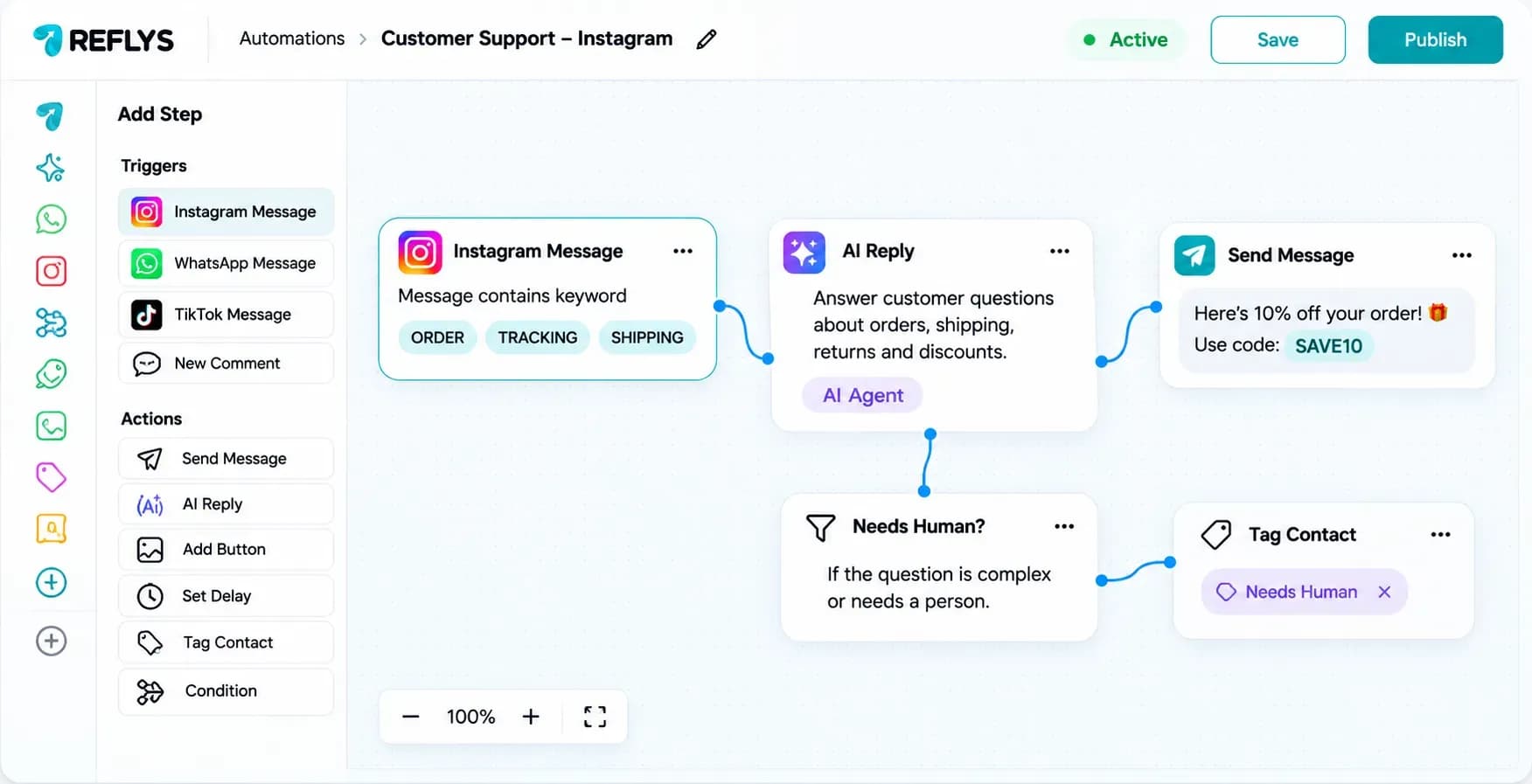
You can launch your first AI reply flow in Reflys in under 10 minutes during the 7-day free trial. This example answers product and shipping questions in Instagram DMs and passes complex chats to your team.
- Start your trial and connect a channel. Connect Instagram or WhatsApp through Meta's official login.
- Connect your store. Link Shopify, WooCommerce, or BigCommerce so you can send discount codes and order updates in chat.
- Describe your goal to the AI Flow Builder. Type something like "Answer sizing and shipping questions, then offer first-time buyers a discount code." Edit the draft flow in the drag-and-drop builder.
- Add an AI step. AI Steps and AI Intention Recognition help the flow understand reworded questions in multiple languages. Pro includes a basic AI builder; Business adds advanced Smart AI.
- Add a human fallback. Tag conversations the AI can't resolve so they land in the unified inbox for your team.
- Test, then go live. Message your account from a second profile, check each reply, then switch it on.
Guides for each screen are in the Reflys Help Center.
Build this flow today: The trial asks for a card, and you're only charged if you keep your plan after 7 days. Start your free trial.
Why Businesses Trust Reflys
Reflys is built on official Meta, WhatsApp, and TikTok APIs, so its AI automations follow platform rules instead of working around them. Reflys holds a 4.9/5 rating on G2 and is trusted by more than 1,000 brands. As of November 2026, Pro costs $12/month, or $9/month billed annually (compare plans).
Start With One AI Flow
AI in customer service works best when it answers your most common question well and hands everything else to a person. Start with one flow, check its answers, then expand. Try Reflys free for 7 days and build your first AI reply flow today.