
Shoppers don't email support anymore to ask about sizing before a drop. They send a DM. The headache starts when half those buyers reply to your Facebook ad in Messenger, while the rest text your support number on WhatsApp. You end up bouncing between apps, losing track of active chats, and watching hot leads go cold.
So, WhatsApp or Messenger? Here is the actual split: WhatsApp runs on phone numbers, hits roughly 98% open rates, and dominates international markets, making it your best tool for order updates and abandoned cart recovery. Messenger ties straight to Facebook and Instagram. It controls the North American market and acts as your top-of-funnel engine for capturing leads directly from social media ads.
You shouldn't pick just one. This guide breaks down exactly where each platform wins, what the API costs look like, and how you can run both simultaneously without hiring a dedicated support agent.
Why Email is Dead for Pre-Sale Questions?
Forcing an interested buyer to fill out a website contact form kills conversions. They want an answer right now. If they wait four hours for an email, they buy from a competitor.
The numbers explain exactly why this shift happened:
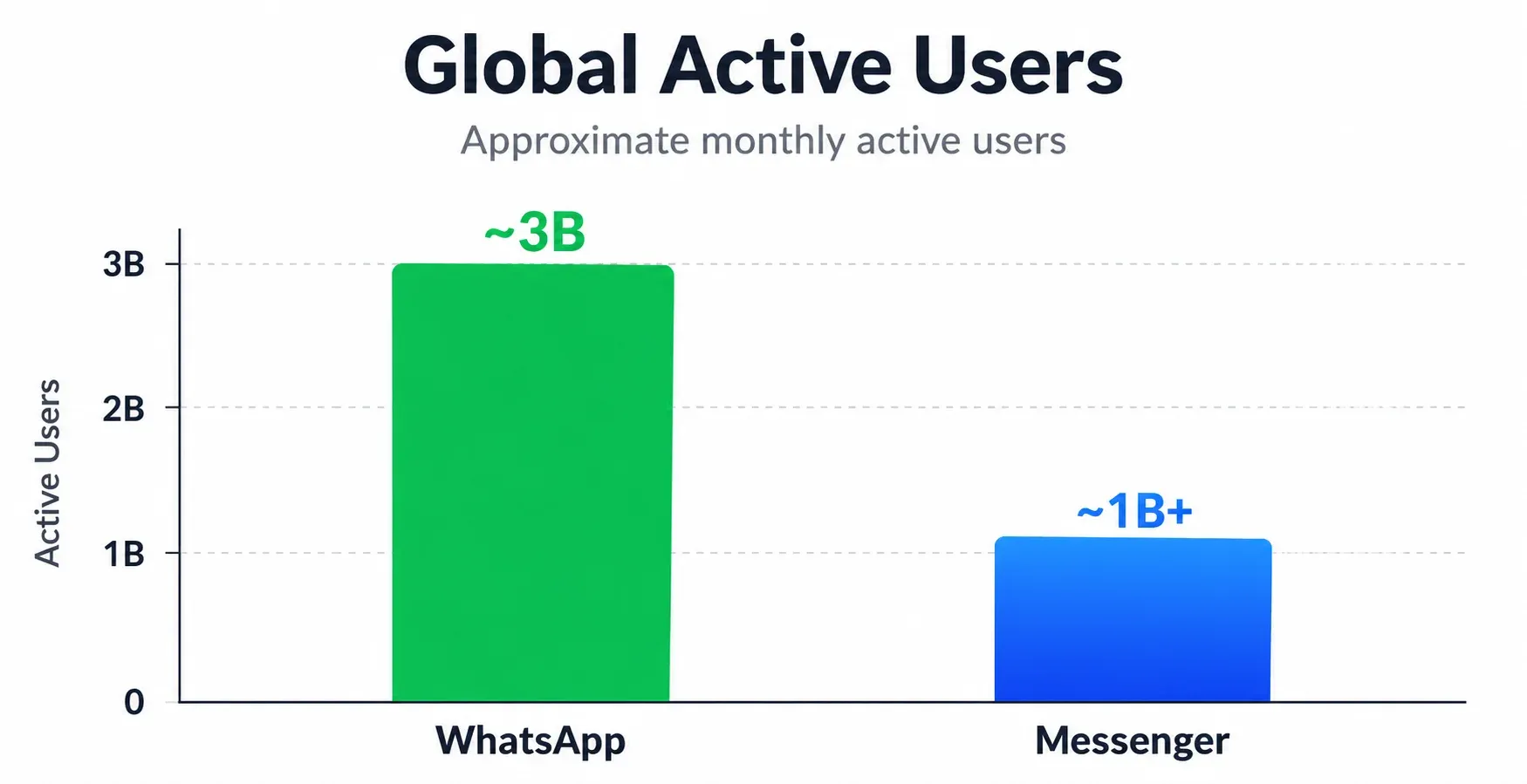
- Over 3 billion people use WhatsApp globally
- Messenger handles billions of brand-to-customer messages every month.
- WhatsApp messages regularly trigger 98% open rates. E-commerce email marketing struggles to hold 20%.
Running a Shopify store means you need a chat strategy. But trying to manage two separate apps by hand turns into an operational nightmare fast.
Quick fix: Stop swapping tabs. Reflys connects WhatsApp and Messenger into one shared inbox during your 7-day trial. You can link your accounts in about10 minutes right here
WhatsApp Business: The Trust and Retention Engine
WhatsApp works using personal phone numbers. Since users are aware that their messages are end-to-end encrypted, they see their messages on WhatsApp as a private and spam-free area.
Meta offers two alternatives. If your business is personally run out of a single phone, the usual WhatsApp Business App will work great. However, WhatsApp Business Platform API is much better if you want your staff to sign into the app, automate responses, and integrate Klaviyo or Shopify.
Where WhatsApp Dominates
- Crazy High Open Rates: Since WhatsApp messages are almost always checked, there is no channel like it for abandoned cart recovery.
- International Reach: Are your target markets in the world regions of Latin America, Europe, Asia, or Africa? Then you need to be selling on WhatsApp.
- High-Trust Transactions: Order issues? Shipping addresses? Customers have no issue discussing order issues with you on WhatsApp because of the security encryption.
Where WhatsApp Struggles
- Cold Traffic: Users don't browse WhatsApp to find new brands. You need to drive traffic there with QR codes, website widgets or Click-to-WhatsApp ads.
- Strict Outbound Rules: Meta has many rules on what you’re allowed to send. If you send a message to a customer past the typical 24-hour service window, one of the message templates that has been cleared is the only option you have.
Messenger for Business: The Ad Traffic Machine
Messenger is a part of Meta. For users that scroll through Facebook, engage with ads or posts, Messenger is the built-in tool for Meta to initiate conversations.
Where Messenger Dominates
- Social Comment Triggers: You can build flows that fire instantly when someone types a specific keyword—like "SHOP"—in your Facebook comments. It's a ridiculously easy way to hand out discount codes during a launch.
- Interactive Chat Menus: Messenger now has native support for carousels of visual products and quick-reply buttons. Buyers don’t leave the chat window to browse your catalog.
- Ad Syncing: Click-to-Messenger ads pull cold traffic straight into an automated flow. You capture their contact info before they even load your website.
Where Messenger Struggles
- Inbox Clutter: Messenger combines private chats, group conversations, and company messaging. Unlike WhatsApp, messages get hidden from view much faster.
- Regional Lean: It owns North America. But if you want to reach LATAM or European buyers, it falls flat.
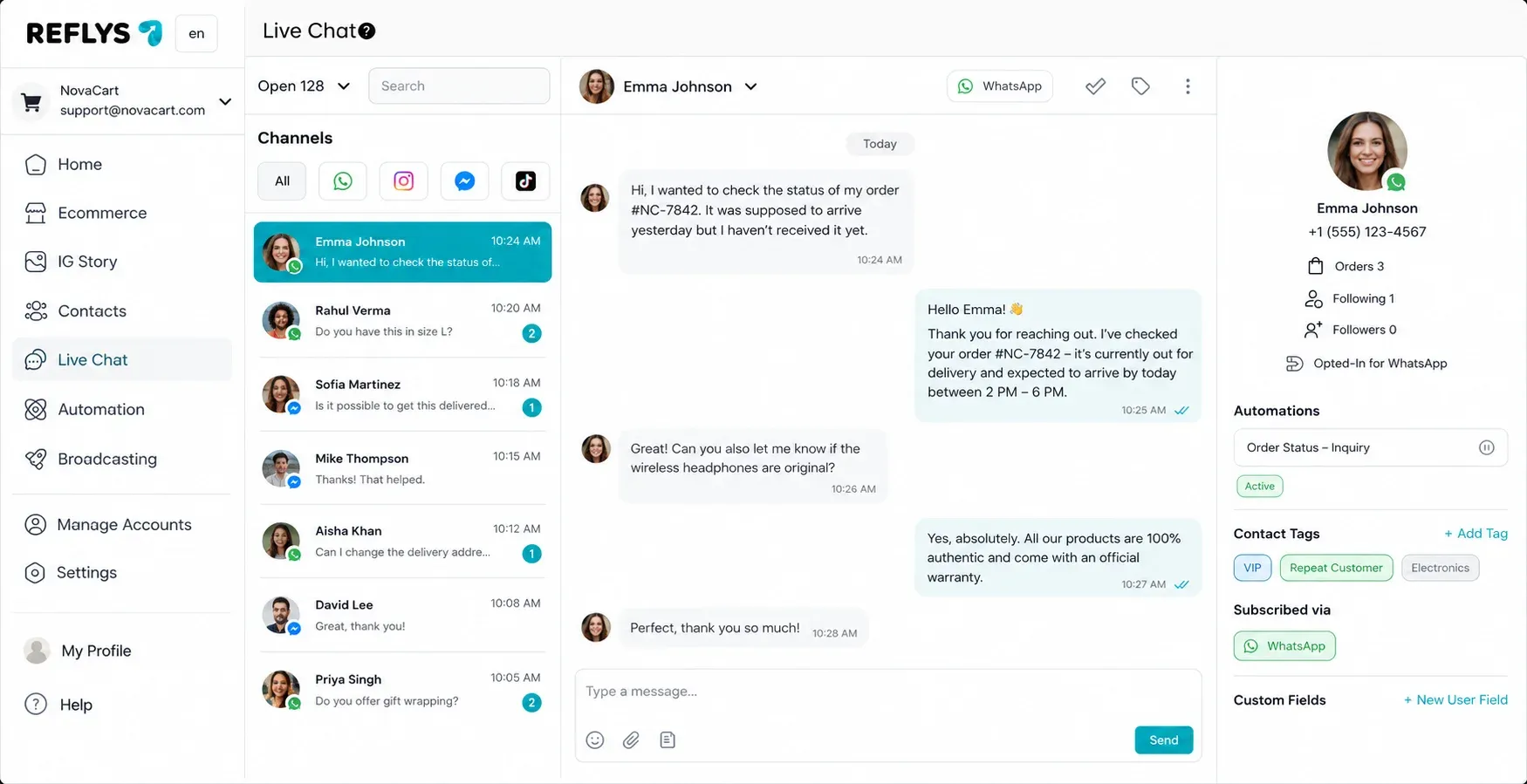
Losing track of customer DMs? Whether a buyer clicks a Facebook ad or texts your WhatsApp line, you can reply from one screen. Reflys merges both channels into a unified team inbox.Start your 7-day trial.
Head-to-Head: WhatsApp vs Messenger
Here is the side-by-side breakdown of how these platforms actually operate in a retail environment.
| Feature | WhatsApp Business API | Messenger API |
|---|---|---|
| Best Used For | Cart recovery, shipping updates, secure support. | Ad lead capture, comment auto-replies, top-of-funnel traffic. |
| Strongest Markets | LATAM, Europe, Asia, Africa. | North America, Western Europe. |
| Typical Open Rates | ~98% (Reads happen almost instantly). | High, but fights against standard inbox noise. |
| Encryption Level | End-to-end by default. | App-level (End-to-end optional). |
| Marketing Rules | Strict. Requires approved templates outside 24h window. | Flexible, as long as you are inside the 24-hour window. |
| How Users Find You | Site chat links, QR codes, Click-to-WhatsApp ads. | Facebook ads, page messages, post comment triggers. |
Why Top Brands Run Both?
WhatsApp and Messenger can't be compared. They target totally different sections of the sales funnel.
Look at this exact cross-channel workflow:
- Acquisition (Messenger): A shopper sees your Facebook ad for a new hoodie. They click. Messenger opens up, and an automated flow offers them a 10% coupon in exchange for their email.
- Checkout (Your Store): They hit your Shopify site, add the hoodie to their cart, get a text from a friend, and close the tab.
- Retention (WhatsApp): Two hours later, an automated WhatsApp message fires off: "Hey, we saved your cart. Tap here to finish checking out with your 10% code applied."
This setup prints money. A Reflys restaurant client ran this exact dual-channel system. They increased monthly online orders by about 35% (from 1,200 to 1,620) with a static advertising budget. Their abandoned cart recovery increased from 6% to 22% after implementing automated WhatsApp follow-ups. See the full breakdown in our case study
To pull this off without paying for three different software tools, you need a single app that bridges the networks.
Set Up Both Channels in Reflys (Under 10 Minutes)
No coding knowledge is required to construct this. Connecting your channels, crafting your initial auto-reply, and directing chats to your team can be done within minutes.
Here is the setup process:
- Go toReflys and sign up.
- Connect your accounts: Hit the 'Channels' tab. Click to link your Facebook Page for Messenger. Then authorize your WhatsApp Business number using the official Meta setup screen.
- Open the Flow Builder: Click on 'Automations' and hit 'Create New Flow'.
- Set your trigger: Setup "Customer sends a message" and select a keyword like "HELP". You can set a trigger that will monitor both Messenger and WhatsApp at the same time for this one action.
- Draft your auto-reply: Type out a quick response: "Hey! Got your message. Are you checking on an order or looking for product info?" Add two quick-reply buttons below the text.
- Test it out: Send that keyword to your own WhatsApp number or Facebook Page from a personal phone. The automation will reply instantly.
Do it right now:
Built on Official Meta APIs (Zero Ban Risk)
Listen closely: do not use random Chrome extensions or cheap scraping tools to automate your messaging.
Meta aggressively monitors for unauthorized API connections. If you use a gray-market tool to mass-message people, Meta will permanently ban your WhatsApp number and lock down your Facebook Business Manager.
Reflys is built entirely on the official Meta and WhatsApp Business APIs. Connecting your accounts through Reflys means you are operating 100% within Meta's terms of service. Your assets stay completely safe.
The Verdict
Pitting WhatsApp against Messenger is the wrong way to look at this. WhatsApp handles your post-click retention, secures the transaction, and saves the abandoned cart. Messenger catches your ad clicks, post comments, and fresh leads.
Keeping them both connected helps you maintain an organized inbox, automatically responds to redundant customer queries, and prevents revenue loss throughout your funnel.
Ready to clean up your DMs?. Setup takes less than 10 minutes.